Beyond Productivity: What Is the Real Business Value of Agentic AI?
Desktops
Generative AI has transformed how we interact with computers, while Agentic AI is revolutionizing how work gets done. The crucial question now is whether this new way of working generates measurable business value.
MSI AI Insights Issue #001 explored why AI is evolving from prompt-based assistants toward autonomous AI agents. Issue #002 examined the next question: as AI becomes part of everyday business operations, where should different AI workloads run?
Issue #003 moves the conversation from technology and infrastructure to value. As Agentic AI increasingly takes on work rather than merely assisting, businesses need to consider how to assess the true worth of this capability.
This article offers a brief introduction to measuring the real business value of Agentic AI. For a comprehensive framework, please refer to MSI AI Insights Issue #003 — Beyond Productivity: Measuring the Real Business Value of Agentic AI.
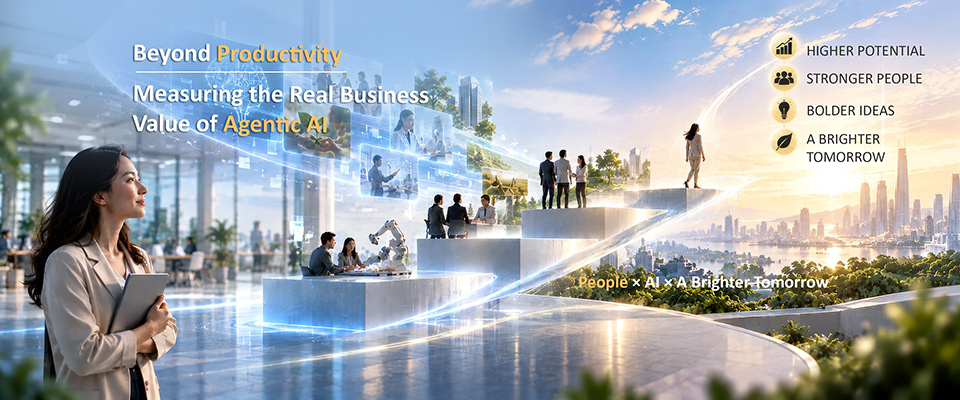
Productivity Is the Beginning, Not the Destination
The first wave of business AI made productivity the easiest measure of success. Metrics such as how much time AI saved, how quickly employees could draft documents, summarize information, generate code, analyze data, or complete routine tasks became the primary focus. While these metrics are useful because they are visible and measurable, productivity alone does not demonstrate that AI has created real business value.
For instance, if AI reduces a task that originally took five hours to just three hours, it creates two extra hours of capacity. The crucial question is: what happens to those two hours?
If employees utilize that capacity to serve more customers, improve quality, explore new opportunities, expedite a product launch, or address previously neglected problems, meaningful value can arise. However, if that extra time is merely filled with more low-value activities, the actual impact on the business may be minimal. Therefore, we need to expand our equation:
AI → Capacity Created → Capacity Reallocated → Business Outcome
The important question shifts from simply asking, "How much more did we produce?" to a more insightful inquiry: "What improvements resulted from our increased productivity?"
From Prompt Economics to Workflow Economics
Generative AI began with a relatively simple interaction: Prompt → Response
AI assistants expanded this concept by assisting users in drafting, researching, analyzing, coding, and retrieving information.
Agentic AI further evolves this relationship. Within defined permissions and constraints, an AI agent can pursue an objective across multiple steps. Depending on its implementation, it may retrieve enterprise knowledge, interact with applications, coordinate tasks, monitor changing conditions, and escalate decisions when human judgment is necessary. As a result, the metrics we use to measure economic value also shift:
Chatbot → Cost per Interaction
AI Assistant → Value per Task
AI Agent → Value per Workflow
Instead of simply counting prompts, tokens, or agent executions, organizations can ask whether the workflow became faster, required fewer handoffs, reduced errors, improved response time, or continued operating when human availability was limited.
For CIOs, CFOs, and business leaders, this shift fosters a more meaningful conversation. Simply recording ten million AI interactions may not accurately reflect business performance. In contrast, a workflow that reduces processing time, increases service capacity, decreases rework, or enables continuous monitoring presents a much clearer business case.
Therefore, Agentic AI should therefore be evaluated not by how autonomous the technology appears, but by how that autonomy improves meaningful business workflows.
The Real Economics of Agentic AI
A common starting point for AI ROI is: Hours Saved × Labor Cost
This formula is useful, particularly for repetitive and high-frequency tasks, but it only captures one aspect of AI's value. A more comprehensive business case can take into account four key areas:
- Direct Value: This includes measurable improvements such as time saved, lower processing costs, increased throughput, and reduced manual effort.
- Indirect Operational Value: This encompasses benefits like greater consistency, reduced rework, faster knowledge retrieval, enhanced operational continuity, and better-informed decision-making.
- Opportunity Value: This value arises when AI makes it economically feasible to carry out tasks that might otherwise be impractical. For example, a team could analyze hundreds of customer comments instead of just a small sample, explore a wider range of design alternatives, uncover insights hidden within fragmented information, or continuously monitor data that employees could only review periodically.
- Cost of Inaction: Maintaining the current operating model can also have economic consequences. Slower decision-making, inefficient use of knowledge, missed opportunities, operational friction, and widening capability gaps can all negatively impact business performance, even if these costs are not directly reflected in an AI budget.

It's important to note that not every AI investment will yield a positive return, and not every organization should implement every AI capability. However, AI economics should consider not only the costs of AI but also what it enables, and what might be lost by not adopting it.
Measuring Enterprise AI Value
To move beyond productivity, organizations need a framework that links AI activities to business performance. MSI AI Insights outlines five levels of this framework:
- Efficiency: This level examines whether tasks can be completed more quickly or with fewer resources.
- EEffectiveness: Here, the focus is on whether the work becomes better—more accurate, consistent, useful, or less reliant on rework.
- ECapability: This level explores what the organization can achieve now that was previously challenging or impractical. Examples include continuous monitoring, large-scale knowledge analysis, rapid experimentation, and multi-step autonomous workflows.
- EBusiness Outcomes: This connects the improvements made to measurable results such as revenue, costs, risk, resilience, time-to-market, customer outcomes, and innovation capacity.
- EHuman Value: Finally, this level asks whether AI enables people to contribute at a higher level. AI can reduce repetitive tasks, improve access to knowledge, allow specialists to focus on complex decisions, or enable smaller teams to pursue opportunities that previously required significantly more resources.
As organizations progress through this value hierarchy, simple productivity metrics become increasingly inadequate. The focus shifts from merely measuring AI usage to understanding how AI enhances outcomes.
AI with L.O.V.E.
Business discussions about AI often center on efficiency, automation, security, and cost. However, as AI becomes more integrated into our work, another important question arises: What should AI help people become better at?
In Mandarin, “AI” sounds like the word for “love”, an idea that inspired MSI AI Insights to introduce "AI with L.O.V.E.," a human-centered framework designed to think beyond mere productivity:
- L — Listen: Understand people, context, intent, and the problems they are trying to solve.
- O — Open: Expand access to knowledge, expertise, and capabilities.
- V — Value: Shift human effort from repetitive tasks to areas that require judgment, creativity, and higher-level work.
- E — Empower: Enable people and teams to achieve more with the time, knowledge, and resources available to them.
Together, the principles form the sequence: Listen → Open → Value → Empower

"AI with L.O.V.E." complements traditional ROI by adding a human dimension to business value. The goal is not only to make work more efficient, but to help people contribute at a higher level and accomplish what was previously difficult or impractical.
Start with the Workflow, Not the Technology
Organizations should not start building a business case for Agentic AI by selecting a model, platform, or infrastructure. Instead, they should begin with the workflow.
First, identify a specific workflow and assess its current performance. Measure the changes that AI brings to this workflow. Then, link these improvements to tangible business outcomes and human value. This process can be summarized as follows:
Workflow → Evidence → Value → Accountability
The goal is not simply to prove that AI works, but to identify where AI creates enough measurable value to justify continued investment.
Key Takeaways
- Productivity is the beginning, not the final measure of AI value.
- PCapacity created only becomes value when it leads to better outcomes.
- PAgentic AI shifts measurement from cost per interaction toward value per workflow.
- PAI ROI includes direct value, indirect operational value, opportunity value, and the cost of inaction.
- PAI value progresses from Efficiency → Effectiveness → Capability → Business Outcomes → Human Value.
- PAI with L.O.V.E. adds a human-centered perspective: Listen → Open → Value → Empower.
- PThe ultimate question is not how much AI an organization uses, but what measurable value that AI creates.
Frequently Asked Questions
What is the real business value of Agentic AI?
Agentic AI creates value when its ability to perform multi-step work improves meaningful business workflows. This may include faster execution, fewer handoffs, reduced rework, better decisions, continuous operations, new capabilities, or measurable business outcomes.
Why isn't productivity enough to measure AI ROI?
Productivity shows whether work becomes faster or less expensive, but it does not prove that a better business outcome occurred. Time saved becomes valuable when the resulting capacity improves quality, cost, revenue, risk, resilience, innovation, or another meaningful outcome.
How does Agentic AI change the AI business case?
Agentic AI can participate across multiple steps of a workflow rather than simply respond to individual prompts. This shifts measurement from cost per interaction and time per task toward value per workflow.
Does AI ROI mainly come from reducing labor costs?
No. Labor efficiency is one component. AI can also create value through greater capacity, better decisions, reduced rework, stronger knowledge access, continuous operations, new capabilities, and opportunities that were previously impractical.
What is opportunity value?
Opportunity value represents work or business opportunities that become practical because AI changes the required cost, capacity, or speed—for example, analyzing more information, exploring more alternatives, or continuously monitoring changing conditions.
What is the AI Value Stack?
It evaluates AI across five levels: Efficiency → Effectiveness → Capability → Business Outcomes → Human Value
The framework helps organizations move from measuring AI activity toward measuring actual organizational impact.
What is AI with L.O.V.E.?
AI with L.O.V.E. stands for Listen, Open, Value, Empower. It is a human-centered framework for evaluating whether AI understands real needs, expands access to knowledge and capabilities, moves people toward higher-value work, and empowers them to accomplish more.
Where should organizations begin?
Begin with a specific workflow. Establish its current baseline, measure what AI changes, connect those improvements to business outcomes, evaluate human value, and continuously review whether the investment continues to create measurable value.
Want to Explore the Full Picture?
MSI AI Insights — Issue #003
Discover how organizations can measure Agentic AI beyond productivity through business outcomes, operational value, human potential, and long-term ROI.
Previous Issue
MSI AI Insights — Issue #002
Explore how workload-first AI strategies are reshaping where enterprise AI runs and how organizations balance Cloud AI, Local AI, governance, performance, and long-term business value.
MSI AI Insights — Issue #001
Understand why AI is evolving from prompt-based assistants to autonomous AI agents and how Agentic AI is reshaping enterprise computing.
Coming Next
MSI AI Insights — Issue #004
Putting AI Agents to Work
Explore a practical framework for turning Agentic AI strategy into real-world business deployment.
Coming Soon.